

Reading is Political
Seven Books to Dive into This Summer

I think I came out of the womb with a love of reading. Of course I’m being facetious, but as long as I can remember, I have enjoyed the comfort of a good book.
I was homeschooled through the 2nd grade, taught to read and write by my diligent and patient mother, whom I imagine must have played a big role in my love of books. Or maybe it was just always destined to be. My brother and sister don’t have the reading bug like I do. While they both read books, they don’t start and end their days with reading. They don’t carry a book or their kindle with them everywhere they go in case there are a few spare moments to read. They don’t accidentally stay until 2am because they’re lost in a story.
I was a diligent and focused student, finishing my schoolwork for the day, usually by noon, and then off to the library I would go in search of my next great adventure. Reading is a gateway to worlds we’ve never experienced, some real and some imaginary. I vividly remember reading nearly every single American Girl book, putting myself in the shoes of Addy, the only Black American Girl (at the time), who although brave and courageous, was enslaved with her family on a plantation. I tore through The Baby-Sitters Club series, delighting in their entrepreneurial spirits and wondering if I could recreate my own babysitting enterprise. And of course, we can’t forget the mystery solving Nancy Drew.
When I entered traditional school for the first time in 3rd grade, I discovered that there were these things called reading contests, and my little heart lit up with joy and excitement. What do you mean I could win a prize for doing something I already loved? A dream come true.
I don’t consider myself a competitive person, but the one thing I was competitive about was winning the monthly reading contests. And for context, I went to a small, Christian school, with an average class size of 20, so the competition wasn’t that steep.
One of my new classmates, Emily, and I became fast best friends, realizing that we lived within walking distance of each other. She was also a big reader and we were often neck and neck in our competitions. We were in a particularly fierce monthly competition with a huge prize and we were within pages of each other but every day, Emily was starting to overtake me. One day we decided to read together after school. Emily pulled out a 1000 page book, I can’t remember the exact book, but it was advanced. Think the Iliad and the Odyssey, fairly intense for 3rd graders. Anyways, as we sat next to each other reading, I noticed Emily flipping through the pages at an extremely fast rate, entirely too fast for a book of that depth. In an instant, it clicked: Emily was cheating. She wasn’t really reading the text in its entirety.
I consider myself a loyal and devoted friend. But when reading competitions and friendship loyalty converged? I fear I was more dedicated to winning the contest.
They say snitches get stitches but apparently that didn’t scare me. I went to school the next day and sang like a bird!
As soon as I arrived, I told my teacher what I had witnessed, adding that I had no proof but felt certain Emily would confess if pressed about the matter. And confess she did. Needless to say, I won the reading contest. In hindsight, am I proud of turning my friend in? Not necessarily, but reading is serious business. You have to win fair and square!
And then of course, there was the summer library reading challenges and the infamous Pizza Hut reading program when you could earn a personal pan pizza after reading a certain amount of books.
In the age of growing anti-intellectualism, I feel the need to talk about the joy of reading for pleasure. This idea that reading isn’t cool or that books aren’t important isn’t just a simple and benign ideology. It’s actually dangerous. I’m a descendant of enslaved people. Slaver owners declared it illegal for enslaved people to learn how to read or write or even own books. They were also often denied the right to know their birthdays, their families of origins, or even their birth parents. Between 1740 and 1867, anti-literacy laws prohibited Black Americans from learning to read or write.
“The alphabet is an abolitionist. If you would keep a people enslaved, refuse to teach them to read.” — Harper’s Weekly, 1867
It was considered dangerous for Black people to know how to read and write because knowledge is power. That’s not just a cute little catchphrase. If enslaved people could read and write, they could understand abolitionist literature. They could read about the slave uprisings happening in other places, like the Haitian Revolution of 1791, the most successful slave uprising in history. They could have read about the Nat Turn slave revolt in 1831. They could organize and revolt in mass. They could help each other plan more coordinated escapes. They were scared of what people could accomplish if they simply had basic literacy skills.
In the current political climate, reading is more important than ever. This administration’s attempt at defunding public libraries isn’t by accident. Libraries offer wide accessibility to the masses and reading empowers people. Just like slave owners didn’t want enslaved people informed, the attack on library funding during a literacy crisis is an attempt to increase illiteracy within our country and simply make it more difficult to access books, information, free internet, computers, and the myriad of other things libraries provide to people.
All that to say, we need to be reading, especially for pleasure. Reading fiction increases empathy, reduces stress, leads to an expanded vocabulary, and can teach you so much. It was through a historical fiction book, With Love From Harlem that I learned about the amazing Harlem Renaissance pianist, Hazel Scott. In Harlem Rhapsody, I explored the life of Jessie Redmon Fauset, a trailblazing Black literary editor who discovered and mentored the likes of Langston Hughes and Countee Cullen. The House of Mirth required me to look up so many words, I started questioning my own educational pedigree. My sister and I now use the word ‘deleterious’ with each in daily conversation just for funsies.
Anyways, all of this is my subtle (maybe not so subtle) attempt at encouraging more people to read fiction. That being said, here are my recommendations to help you get lost in a book this summer.
Kin by Tayari Jones
The year is still young but so far, this is my absolute favorite read of the year. To be fair, I’m a Tayari Jones stan. I read An American Marriage in 2019 after stepping away from fiction during my dreaded self-help and self optimization phase (do not recommend) and it reignited my love for fiction reading. While An American Marriage is not an official member of this list, you should absolutely read it. Also, I love authors who read their DMs and comments. While I realize that everyone doesn’t have the capacity or the desire, I swoon over a response from an author. After posting in my stories about how much I was enjoying Kin, Tayari responded to my stories and offered to send me signed nameplates to add to my book. She actually sent them!
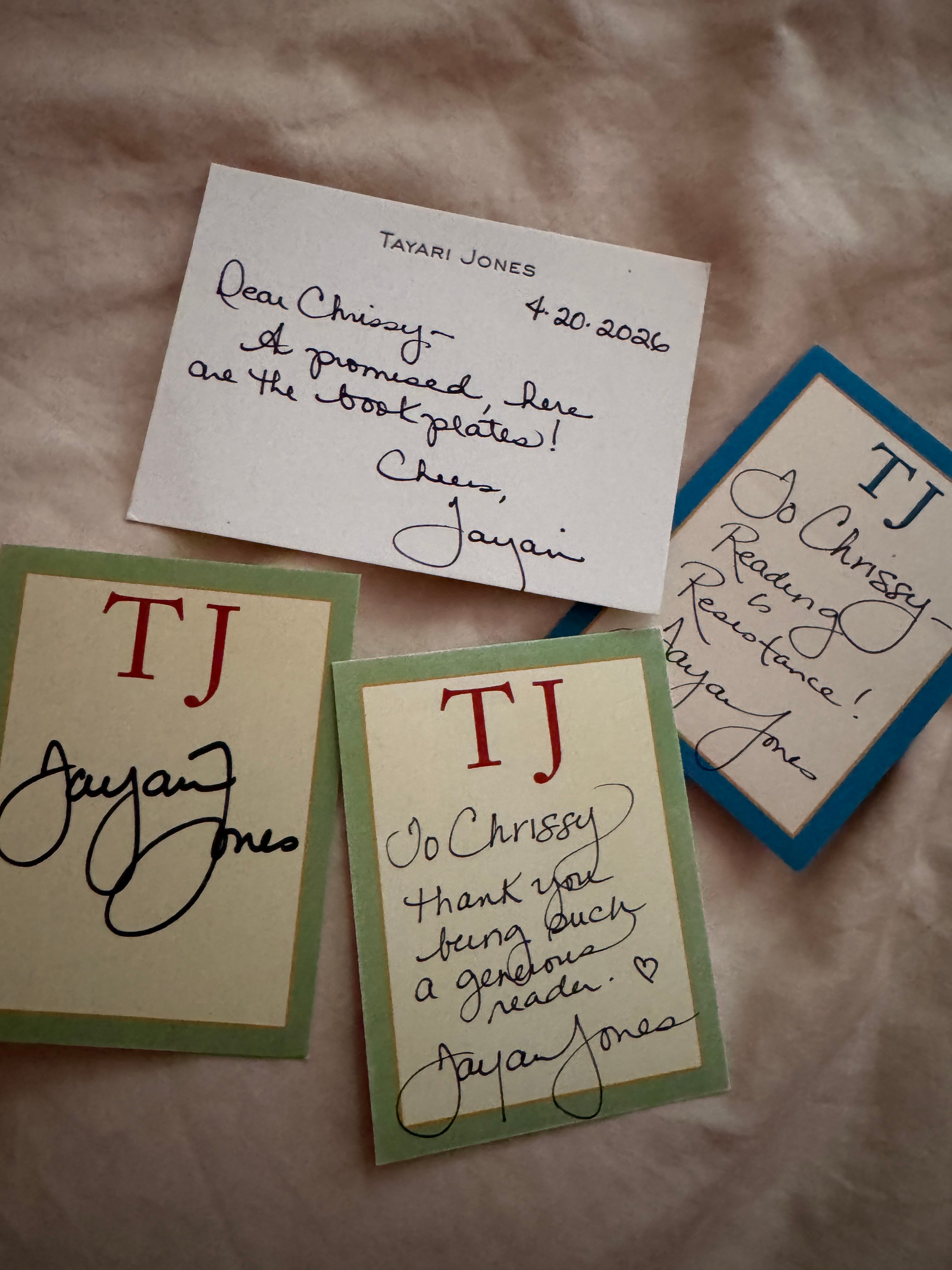
Anyways, I digress. Kin is the beautiful and heartwrenching story of two motherless friends, Vernice and Annie, raised in the deep South. Best friends since birth, it’s an emotional story of friendship, sisterhood, and the ways in which life can take you down very different paths.
The Seven Daughters of Dupree by Nikesha Elise Williams
One thing about me, I’m a historical fiction hoe (and I mean that in the most positive way). Nothing brings me more joy than reading a multi generational story. I want to know exactly how we got to the present day. The Seven Daughters of Dupree follows 7 generations of women navigating love, loss, and family secrets. It’s emotional, compelling, and beautifully written.
Girls Our Age by Phoebe Thompson
I had the opportunity to read an advance copy of this book, and I loved it so much I chatted with the author. It’s a story of three young women navigating friendship, girlhood, and identity, while tackling themes of disordered eating and mental health.
You can watch our interview below:
The Sisters by Jonas Hassen Khemiri
This story follows three sisters over the course of three decades, exploring themes of loss, love, grief, and mental health. I’m a sucker for a long book that follows the life of multiple characters. At almost 700, pages this book does exactly that. My only critique is that the last 100 or so pages felt a little unnecessary but I still highly recommend it.
The Wilderness by Angela Flourney
In the same theme as the book above, The Wilderness follows the friendship of five Black women over the course of twenty years through college, marriage, and motherhood. It’s a heartwrenching depiction of adulthood, living through social and political unrest, and the bonds of female friendship.
Strange Girls by Sarvat Hasin
Strange Girls is the story of two estranged best friends forced back together by a mutual friend’s wedding nuptials. After a decade of not seeing each other they are left to confront all the unspoken truths of the past. It examines codependency in friendships and it’s beautifully written and compelling.
Score by Kennedy Ryan
I’m a romance reader who hasn’t been reading much romance lately, mainly because I’ve been really into literary fiction so romance has been on pause. But when Kennedy Ryan releases a new book, I read it. Score is the sequel to Reel, which is by far, my favorite Kennedy Ryan book. What I love about Kennedy’s work is that it’s never one dimensional. This book is not just a love story. It’s a story about mental health, second chances, and vulnerability.
Up next, I’m reading:
Thank you so much for reading The Liberation Collective. I’m eternally grateful to have you here. You can also follow along on Instagram and TikTok. And if you want to partner with me, you can email me at info@chrissyking.com
Enjoyed this article but not ready or able to become a paid subscriber? Buy me a coffee instead.

P.S. — my inner circle is where people get all the extras — journal prompts, my favorite things, and behind the scenes bonuses.

Support Black Women Writers.
Your support as a paid subscriber on my Substack is essential to sustaining the work I do. I’m committed to keeping my writing accessible to everyone, but to maintain this structure, I need your help. By subscribing, you’re not just supporting me, a Black woman writer, you’re investing in a platform that’s committed to sharing meaningful and thoughtful content.
Please consider joining as a paid subscriber today to support my work.
"dreaded self-help and self optimization phase (do not recommend)" haha, love it
I had a similar experience with a reading contest when I was in about 3rd grade. I lived in Japan at the time and attended an international school. I was in heavy competition for a medal for a reading competition with a boy in my class. I was not going to let a boy beat me! Haha. He called my apartment on our landline (oh, the good old days) and my mom thought he was a girl because his voice was so high. He was determined to beat me, but I won out in the end and I think I still have the medal somewhere in my old memory boxes.
I read about 300 books per year now, so I like to think I’d still trounce him about 25 years later.😂